- Ecobrief
- Posts
- 🌳 Guess what? Lab-grown wood could save our forests (Inside) #26
🌳 Guess what? Lab-grown wood could save our forests (Inside) #26

Ecobrief
January 05, 2026
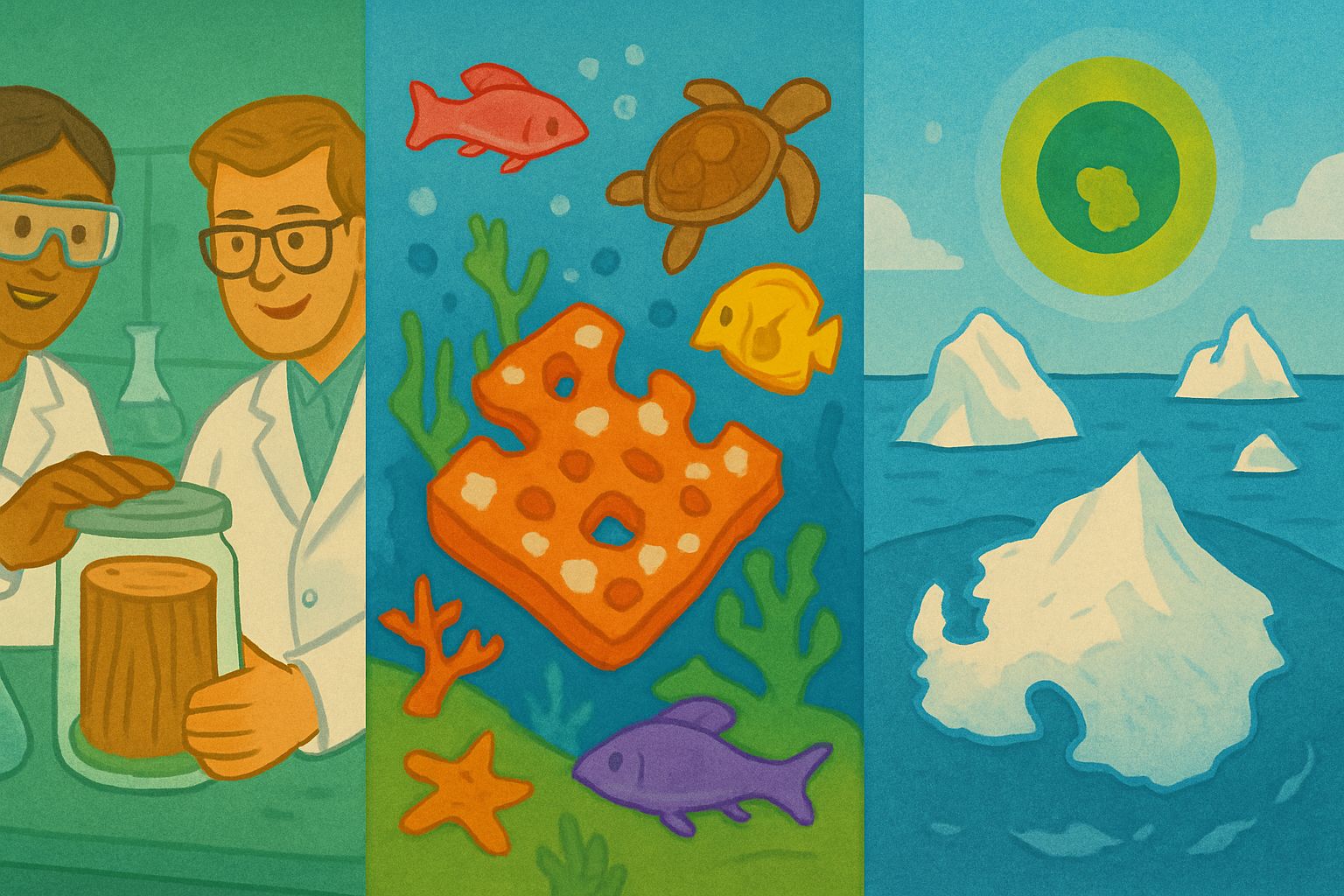
This week, the future got a little greener as innovation tackled some of Earth’s toughest sustainability challenges. Scientists are growing real wood in labs, offering a sustainable alternative that could dramatically shrink deforestation’s footprint. Meanwhile, a 3D-printed coral support tile achieved an astonishing 95% coral survivorship rate, reviving reefs and marine life where restoration tools once failed. And in Antarctica, the ozone hole has shrunk to its smallest in six years, peaking at 21 million square kilometers, a win credited to global teamwork.
Ready to meet a surprising tech hero? Our Deep Dive spotlights Finland’s “sand battery,” a giant heat-storing silo that keeps towns cozy and could cut carbon emissions by 70%. Curious how sand might heat your own city? Let’s dig in. ⬇️
🌍 Lab-Grown Wood: A Sustainable Future
Key discovery: Advancements in tissue culture technology are enabling the cultivation of wood in laboratory settings, offering a sustainable alternative to traditional forestry.
The demand for wood products continues to rise, leading to deforestation and environmental degradation. To address this, scientists are exploring the potential of growing wood in labs using tissue culture techniques. This method involves cultivating plant cells under controlled conditions to produce wood-like materials without the need for tree harvesting. By manipulating growth hormones and environmental factors, researchers can guide cell differentiation to form structures resembling natural wood. This innovation not only reduces the pressure on natural forests but also offers a customizable approach to wood production, allowing for the creation of materials with specific properties tailored to various applications. While still in the experimental phase, lab-grown wood holds promise for revolutionizing the forestry and construction industries by providing a renewable and eco-friendly resource. (plantcelltechnology.com)
Quantified benefit: Potential to significantly reduce deforestation and associated environmental impacts.
🌍 3D-Printed Tiles Revive Coral Reefs
Key initiative: Archireef, a startup, has developed 3D-printed terracotta tiles that have achieved a 95% coral survivorship rate in restoration projects.
Coral reefs, vital to marine biodiversity and coastal economies, have suffered significant declines due to climate change and human activities. Archireef addresses this crisis by creating reef tiles using 3D printing technology and terracotta clay, materials conducive to coral growth. These tiles are designed to mimic natural reef structures, providing a stable foundation for coral fragments. In Hong Kong, the deployment of these tiles resulted in a 95% coral survivorship rate over three years, surpassing traditional restoration methods. Building on this success, Archireef has expanded to Abu Dhabi, deploying tiles and saving 1,200 coral fragments. This innovative approach not only restores coral habitats but also attracts marine life, contributing to the overall health of the ecosystem. (cnn.com)
Quantified benefit: Achieved a 95% coral survivorship rate over three years, exceeding traditional restoration methods.
🌍 Antarctic Ozone Hole at Smallest Since 2019
Key discovery: In 2025, the Antarctic ozone hole reached its smallest and shortest-lived state since 2019, indicating progress in atmospheric recovery.
The ozone layer acts as Earth's protective shield against harmful ultraviolet radiation. In 2025, scientists observed that the Antarctic ozone hole peaked at 21 million square kilometers in September, a reduction from 26 million square kilometers in 2023. This shrinkage is attributed to the global ban on ozone-depleting substances initiated by the 1987 Montreal Protocol. The earlier closure and reduced size of the hole are seen as reassuring signs of the ozone layer's recovery. However, scientists caution that full restoration to 1980 levels is expected by 2066, emphasizing the need for continued adherence to environmental regulations. (theguardian.com)
Quantified benefit: Ozone hole reduced to 21 million square kilometers in 2025, down from 26 million in 2023.
📖 Deep Dive: The Giant Sandbox That's Heating a City
In a small Finnish town, a revolutionary new technology is solving one of renewable energy's biggest challenges by storing clean power for the coldest winter days inside a giant silo of sand.
1. Problem Solved (The Big Idea):
This brilliant, low-cost "sand battery" captures intermittent and cheap renewable energy and stores it as heat for months at a time, providing a stable, clean heat source for entire communities when they need it most.
2. Tech Explanation (A Food Metaphor):
So, how do you store energy in sand? Imagine a city-sized slow cooker. The recipe starts with a simple, abundant ingredient: sand. When solar and wind farms produce more electricity than the grid needs (especially on sunny, windy days), that excess, cheap power is used to heat up the sand inside a massive, insulated steel silo to scorching temperatures, around 600°C (1112°F). This is the "low and slow" cooking process.
Just like a cast-iron pot or a pizza stone that stays hot long after you turn off the oven, the densely packed sand is incredibly good at retaining this heat. When energy is needed, especially during dark, freezing winter periods, hot air is circulated through pipes in the sand, and this heat is used to warm water for the local district heating network, which then flows to homes, offices, and the local swimming pool. It's a simple, brilliant way to "batch cook" energy when it's cheap and "serve" it as a warm, comforting meal for the entire town, week after week.
3. Global Potential (The Inspiring Metrics):
The potential here is enormous, especially for northern climates. The new sand battery in Pornainen, Finland, the world's largest, is a 13-meter-high silo that can store a whopping 100 MWh of thermal energy, equivalent to the heating needs of the town for an entire week in winter. This single installation is projected to reduce the district heating network's CO2 emissions by nearly 70% by replacing the use of oil. Because sand is cheap, durable, and can be heated and cooled thousands of times without degrading, this technology offers a scalable solution for industrial processes and cities worldwide that rely on high-temperature heat.
4. Wisdom from the Source:
As Tommi Eronen, the CEO of the company Polar Night Energy, puts it: "We wanted to build something that can be a real game-changer. A scalable heat storage that can actually make a difference in the real world."
Why is this important for you?
This isn't some far-off, complex solution. It’s a powerful demonstration of how simple, accessible materials (literally, builder's sand!) can solve incredibly complex problems. It proves that the green transition doesn't always require rare minerals or futuristic tech. Just as making a healthy meal plan for the week helps you avoid junk food, this technology helps communities avoid fossil fuels by smartly planning and storing their energy. It’s a local initiative with massive global implications, showing that with a little ingenuity, every community can build a more resilient and sustainable energy future from the ground up.
Search Sources
➡️ polarnightenergy.com
➡️ districtenergy.org
➡️ futura-sciences.com
➡️ impactloop.com
➡️ newatlas.com
➡️ bbc.com
💡 5 Quick Wins
🔌 Kill “vampire” power at the TV corner with a smart strip: Saves ~20-70 kg CO₂/year
Auto‑cuts standby to TV/console/set‑top/soundbar when the TV goes off. Typical standby is 10-20 W 24/7, hundreds of kWh over a year. One €20–€30 strip pays back fast and you never think about it again.
🔌 Fit a 7-8 L/min showerhead and cap showers to 5-6 minutes: Saves ~80-250 kg CO₂/year
Heating water is your second or third biggest winter energy load. Dropping flow from ~12 L/min to ~8 L/min and trimming 2 minutes saves 100–300 kWh/year. Same comfort, lower bills, less condensation in winter.
🥦 Make your weekday coffee(s) with oat milk instead of dairy: Saves ~40-80 kg CO₂e/year per person
Swapping 100-200 mL/day from cow’s milk (1.1-1.3 kg CO₂e/L) to oat (~0.2-0.4) cuts ~0.7–1.0 kg CO₂e per litre, small habit, big annual effect. You keep the ritual; the footprint quietly shrinks.
🥦 Replace two bottles of sparkling water per week with tap + home carbonation: Saves ~15-40 kg CO₂e/year
You avoid bottle production and transport. One CO₂ cylinder carbonates dozens of litres; the tap water footprint is tiny by comparison. Less lugging, less plastic, same bubbles.
✈️ No winter idling; EVs: preheat while plugged in: Saves ~10-40 kg CO₂/year (ICE); extends range for EVs
Don’t warm up an ICE car at the curb, drive off gently within ~30 seconds. Idling burns ~0.6-1.0 L/hour. For EVs, schedule cabin preheat on the charger to avoid cold‑start battery drain. Warmer cabin, cleaner air on your street, and fewer “dirtiest” cold‑start kilometres.
Quote of the Week
"Combustion is not a sustainable option for the climate or the environment. This project is a powerful example, that effective solutions for mitigating climate change do exist.", Liisa Naskali, Chief Operating Officer of Polar Night Energy, the Finnish company behind the Sand Battery technology and a pioneer in high‑temperature thermal energy storage solutions.
🎊 Cheers to 2026, hope-spreaders! As we toast to new beginnings, here's a resolution that's actually fun to keep: being the friend who shares good news instead of doom-scrolling disasters. While everyone's debating whether this year will be "their year," you can help make it someone else's by passing along a little optimism. It's like being a happiness dealer, but completely legal and way more rewarding!