- Ecobrief
- Posts
- 🌎 Heard about FEVVERS, the vegan feather rewriting fashion? #29
🌎 Heard about FEVVERS, the vegan feather rewriting fashion? #29

Ecobrief
January 26, 2026
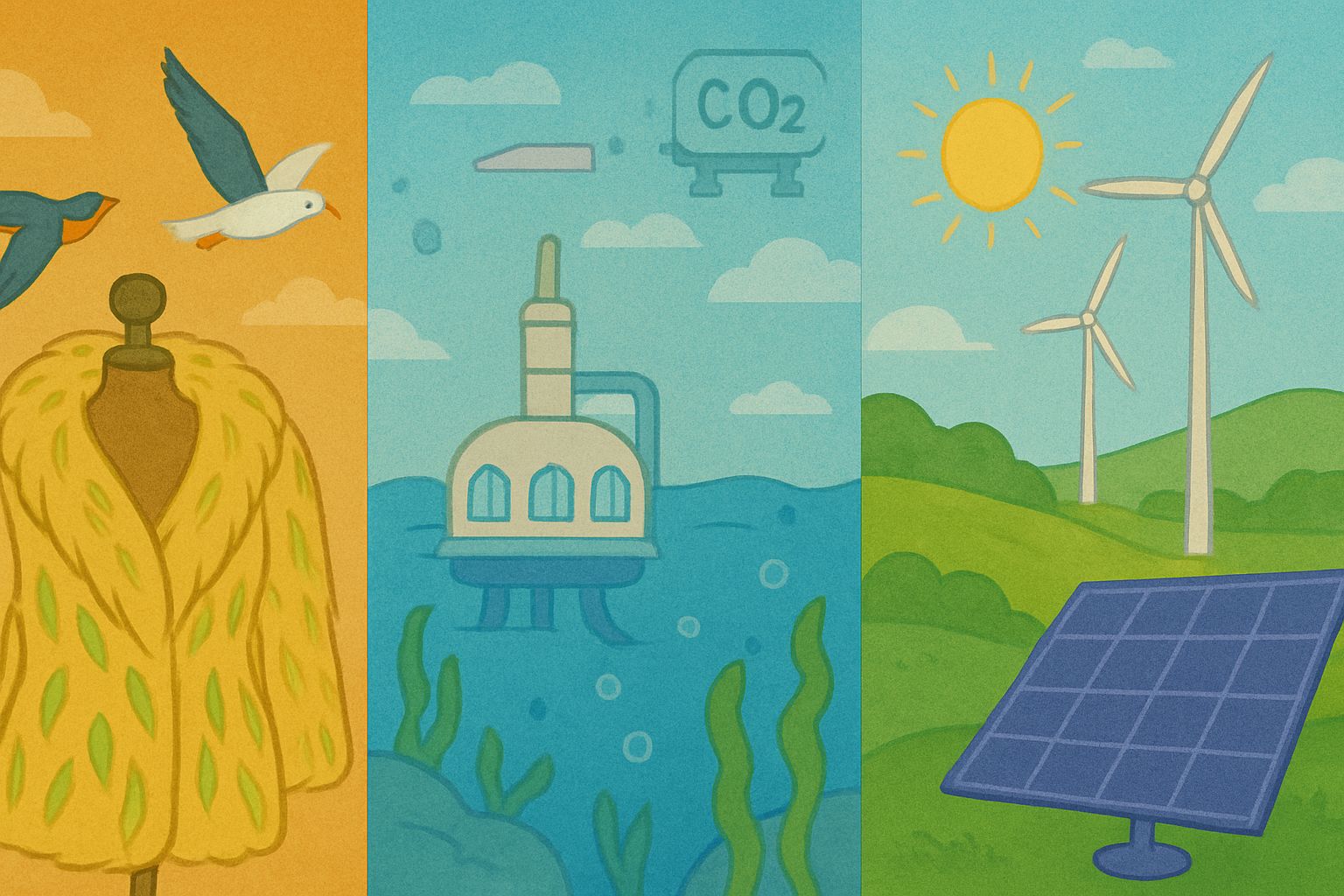
This week, the future got a little greener, and smarter. Stella McCartney just unveiled FEVVERS, a plant-based feather that could save billions of birds while keeping high fashion truly cruelty-free. Meanwhile, Norwegian innovators plan the world’s first underwater desalination plant, aiming to cut energy use by up to 50%, a splashy solution as global water demand is set to outpace supply by 40% in just a few years.
And, for the first time, wind and solar have leapfrogged fossil fuels to power 30% of the EU’s electricity. But how do we tackle carbon already in the air? Our Deep Dive explores the new machines scrubbing CO2 from our skies, and why pairing personal action with breakthrough tech might be climate’s winning combination. ⬇️
🌍 Stella McCartney Unveils Vegan Feathers
Key initiative: Stella McCartney introduced FEVVERS, a plant-based alternative to traditional feathers, at her Spring/Summer 2026 show in Paris.
Renowned for her commitment to cruelty-free fashion, Stella McCartney has taken a significant step by launching FEVVERS, a vegan substitute for feathers. Crafted from plant-derived materials and dyed with natural substances, FEVVERS replicates the lightness and texture of real feathers without harming birds. McCartney emphasized the ethical aspect, stating, "You get the same effect (as feathers), and you’re not killing billions of birds." This innovation aligns with her brand's 25-year legacy of avoiding animal skins, fur, and leather, reinforcing a dedication to sustainable and humane fashion practices. (veganfoodandliving.com)
Quantified benefit: Eliminates the need to pluck billions of birds for fashion purposes.
🌍 World's First Underwater Desalination Plant
Key initiative: Norwegian startup Flocean plans to launch the first subsea desalination plant in 2026, utilizing ocean pressure to reduce energy consumption.
Flocean's innovative approach involves placing desalination facilities at depths of 300–600 meters, harnessing natural ocean pressure to drive the desalination process. This method is projected to cut energy use and greenhouse gas emissions by 30-50% compared to traditional land-based plants. The initial plant, Flocean One, aims to produce 1,000 cubic meters of fresh water daily, with potential scalability up to 50,000 cubic meters per day to meet the needs of cities, industries, and agriculture. This technology offers a sustainable solution to the global freshwater crisis, where demand is expected to outstrip supply by 40% by 2030. (interestingengineering.com)
Quantified benefit: Reduces energy use and greenhouse gas emissions by 30-50% compared to traditional desalination methods.
🌍 Wind and Solar Surpass Fossil Fuels in EU
Key discovery: In 2025, wind and solar energy generated more electricity in the European Union than fossil fuels for the first time.
A report by the think tank Ember reveals that wind and solar power contributed 30% of the EU's electricity in 2025, surpassing the 29% generated by fossil fuels. This shift is largely attributed to the rapid expansion of solar energy, which grew by 20% from the previous year, reaching a record 13% of EU electricity production. Countries like Hungary, Cyprus, Greece, Spain, and the Netherlands saw solar power account for over 20% of their electricity. This milestone signifies a significant move towards cleaner energy sources and a reduction in reliance on fossil fuels within the EU. (yale.edu)
Quantified benefit: Wind and solar provided 30% of the EU's electricity in 2025, surpassing fossil fuels' 29% share.
📖 Deep Dive: The Rise of the Carbon-Filtering Machines
As our global carbon budget shrinks, new technology is scaling up to clean the air itself, offering a vital tool to remove historical CO2 emissions directly from the atmosphere.
1. Problem Solved (The Big Idea):
Direct Air Capture (DAC) technology addresses the critical problem of existing atmospheric carbon dioxide, effectively acting as a filter to remove pollution already emitted over decades.
2. Tech Explanation (A Food Metaphor):
How can you possibly filter CO2 out of the air? Think of it like making gourmet clarified butter. When you melt butter, you get a mix of milk solids and pure butterfat. To clarify it, you gently heat it and skim the "unwanted" solids off the top, leaving only the pure, golden liquid behind. A direct air capture facility works in a similar way. It uses giant fans to pull in huge volumes of ambient air, our "unclarified butter."
This air passes over special filter materials or through a chemical solution that is specifically designed to bond only with CO2 molecules, like a molecular skimmer that only picks up the milk solids. Everything else (nitrogen, oxygen, etc.) passes right through. Once the filters are full, heat is applied to release the captured CO2 in a pure, concentrated form, which can then be permanently stored underground or used to create sustainable products like fuels and building materials.
3. Global Potential (The Inspiring Metrics):
While still a young industry, DAC is gaining serious momentum. As of early 2026, major projects like "Mammoth" in Iceland are operational, each capable of capturing thousands of tons of CO2 per year. The International Energy Agency projects that to meet our global net-zero goals by 2050, DAC will need to scale up to capture nearly one billion tons of CO2 per year by 2030. This rapid expansion is driving innovation and reducing costs, which have fallen significantly from early estimates. Investment is pouring in, with governments and private companies committing billions, signaling a massive scale-up that could create thousands of jobs in engineering, construction, and geology.
4. Wisdom from the Source:
As Dr. Jan Wurzbacher, co-founder and co-CEO of Climeworks, a leading DAC company, stated regarding their new plant: "This indicates a significant step in the race to scale-up direct air capture, a technology vital for achieving the Paris Agreement’s climate goals."
Why is this important for you?
It's easy to feel like our climate problem is a runaway train with no emergency brake. DAC represents one of the first truly viable emergency brakes we have. Why does this matter for your own green initiatives? Think of the "salad and the gym" effect. Reducing your personal carbon footprint, by driving less, consuming consciously, or using clean energy, is like eating that salad. It’s the essential, primary action for getting healthy. Supporting and advocating for technologies like DAC is like adding a powerful workout to your routine; it accelerates the overall result. One doesn't replace the other; they are most powerful when done together. Our individual actions reduce future emissions, while DAC helps clean up the mess we've already made, creating a two-pronged approach that gives us a real, fighting chance at a stable climate future.
Search Sources
➡️ climeworks.com
➡️ energy.gov
➡️ wri.org
➡️ iea.org
➡️ carbonherald.com
💡 5 Quick Wins
🪟 Add temporary “second glazing” film to the coldest windows: Saves ~5–10% space‑heating
Install clear shrink film or magnetic acrylic on single/older double glazing. Two hours, €20–€50 per room. February nights drive conductive and convective losses; a still‑air layer = warmer rooms without higher setpoints.
🏠 Plug an unused fireplace with a chimney balloon or tight cover: Saves ~1–3% space‑heating
Warm air can vanish up the flue all winter. Fit an inflatable chimney balloon (leave a visible reminder tag) or a sealed board with weatherstrip. Fewer drafts, fewer boiler/heat‑pump cycles, cosier living room.
❄️ Defrost the freezer + clean fridge coils and door gaskets: Saves ~20–60 kWh/year (8–25 kg CO₂e)
Frost >5 mm can raise consumption 10–30%. Aim for −18°C freezer and ~4°C fridge; vacuum coils; replace cracked seals. A one‑hour job locks in year‑round savings, and February is ideal as outdoor air keeps food cold during the swap.
⚡ Shift dishwashing and laundry to greener, cheaper hours: Cuts appliance emissions ~10–30%
Use delay‑start to run after 22:00–06:00 or during windy afternoons (common in February). If you have time‑of‑use tariffs, you save € too. Same clean plates, lower grid‑intensity and bills, set it once per cycle.
🧊 Heat‑pump winter tune‑up (no settings, just airflow): Boosts efficiency ~5–10% in cold weather
Clear 30–50 cm around the outdoor unit, brush off snow/leaves, gently straighten bent fins, and clean indoor filters. Unrestricted airflow shortens defrost cycles and keeps COP up when you need it most.
Quote of the Week
"We grew blades of grass and naturally dyed them and then hand-stitched them onto incredible silhouettes. You get the same effect (as feathers), and you’re not killing billions of birds.", Stella McCartney, pioneering luxury fashion designer known for her 25-year commitment to cruelty-free materials, leading innovations in vegan leather and other plant‑based textiles, and influencing global fashion houses toward more sustainable practices.
💝 February's here, and while everyone's focused on Valentine's Day romance, here's a different kind of love story: falling in love with being the friend who spreads hope. Think of it as speed-dating, but instead of awkward small talk, you're matchmaking people with optimism. It's like being Cupid, except your arrows are filled with good news instead of questionable life choices. Who knows? You might just help someone fall in love with the world again.