- Ecobrief
- Posts
- 🌎 Inside: How a Swedish mall turns trash into jobs and profit #25
🌎 Inside: How a Swedish mall turns trash into jobs and profit #25

Ecobrief
December 30, 2025
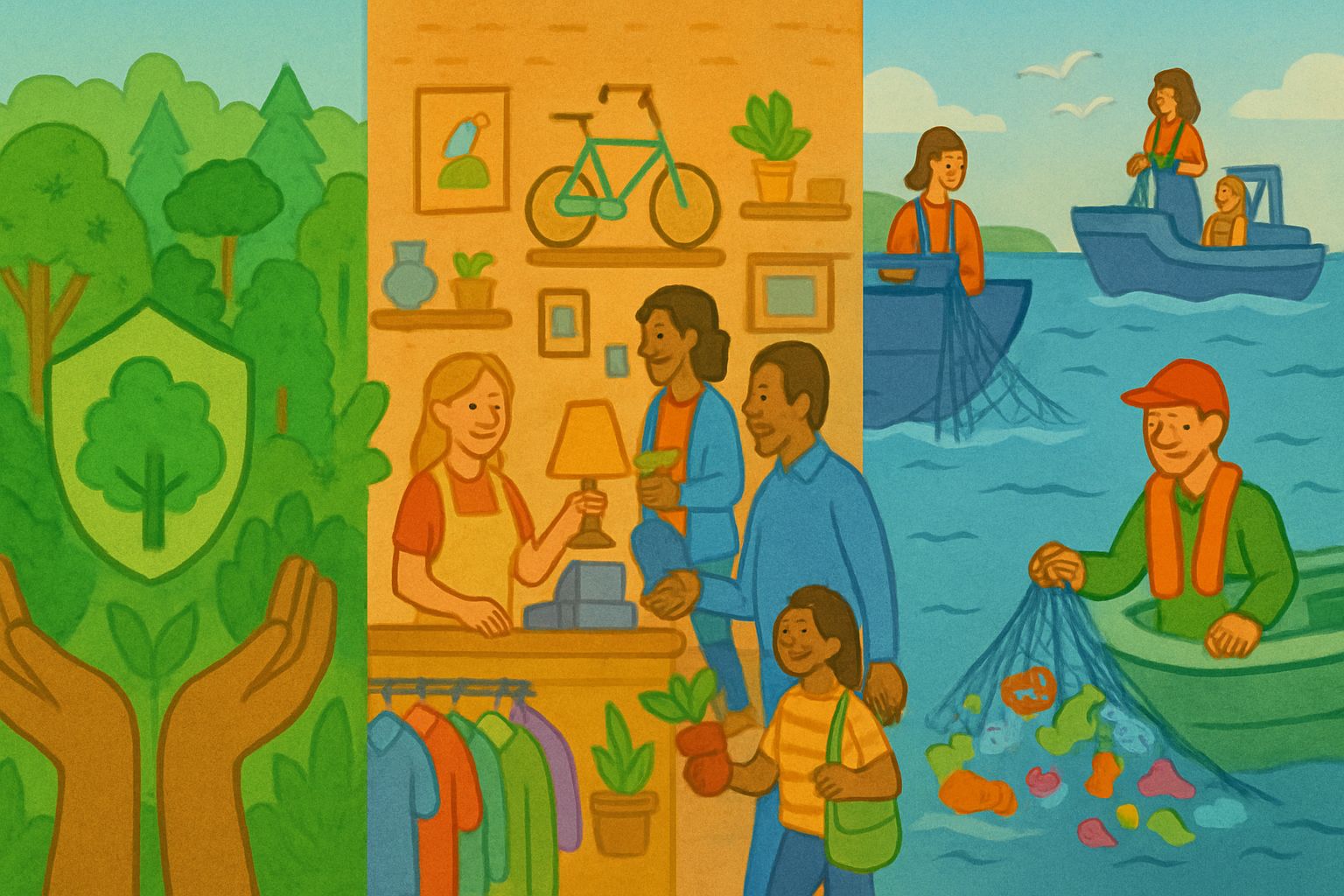
This week, the future got a little greener with three stories proving sustainable progress is everywhere. Norway committed a record 4 billion NOK a year to rainforest preservation until 2035, bolstering efforts to protect critical green lungs like the Amazon. Sweden’s ReTuna recycling mall continues to flourish, transforming unwanted items into 11.7 million SEK in sales and 50-plus new jobs, showing that shopping can be both eco-friendly and lucrative.
And The Ocean Cleanup project has already hauled an astonishing 2,500 tonnes of plastic from our seas, pushing toward a 90% reduction goal by 2040. Want to know what’s next? Our Deep Dive explores the rise of power-generating windows, an innovation that could quietly revolutionize energy in every building you see. ⬇️
🌍 Norway Extends Rainforest Initiative
Key initiative: Norway has extended its International Climate and Forest Initiative (NICFI) until 2035, committing to continued support for rainforest preservation.
Norway's NICFI, a pivotal program in global climate and nature conservation efforts, has been extended by five years, now running through 2035. This extension underscores Norway's dedication to protecting tropical rainforests, which play a crucial role in mitigating climate change and preserving biodiversity. The initiative focuses on reducing deforestation in key rainforest nations such as Brazil, Colombia, and Indonesia. In 2024, Norway increased its annual contribution to 4 billion NOK (approximately 380 million USD), reflecting the program's significance. The NICFI has already yielded positive outcomes, including a notable decrease in deforestation rates in participating countries. However, challenges persist, with regions like the Amazon experiencing severe forest fires and droughts, largely due to ongoing deforestation. Norway's continued commitment aims to address these issues by supporting sustainable forest management, enhancing monitoring systems, and promoting the rights of local communities to manage forest resources. (nicfi.no)
Quantified benefit: Norway's annual contribution of 4 billion NOK supports efforts to reduce deforestation in key rainforest countries.
🌍 Sweden's ReTuna: A Recycling Mall
Key initiative: ReTuna Återbruksgalleria in Eskilstuna, Sweden, is the world's first recycling mall, exclusively selling recycled and upcycled goods.
Opened in August 2015, ReTuna Återbruksgalleria revolutionizes shopping by offering only recycled, reused, or sustainably produced items. Located adjacent to the city's recycling center, the mall allows visitors to drop off unwanted items, which are then sorted and distributed to various shops within the mall. These shops repair, upcycle, and sell the items, giving them a new lease on life. The mall houses 14 stores, including those specializing in electronics, fashion, and home furnishings. Beyond retail, ReTuna serves as an educational hub, hosting workshops and lectures on sustainability and circular economy principles. In 2018, the mall generated sales of 11.7 million SEK (approximately 1.3 million USD) from recycled products and created over 50 new jobs. This innovative approach not only reduces waste but also promotes sustainable consumption and local employment. (retuna.se)
Quantified benefit: In 2018, ReTuna generated 11.7 million SEK in sales from recycled products and created over 50 new jobs.
🌍 Ocean Cleanup Targets 90% Plastic Reduction
Key initiative: The Ocean Cleanup, founded by Boyan Slat, aims to reduce floating ocean plastic by 90% by 2040 using large-scale cleanup systems.
Established in 2013 by then-18-year-old Boyan Slat, The Ocean Cleanup has developed advanced technologies to remove plastic pollution from oceans and rivers. Their systems capture plastic debris, preventing it from harming marine ecosystems. As of July 2023, the organization has removed approximately 2,500 tonnes of plastic from the Pacific Ocean. Their goal is to reduce floating ocean plastic by 90% by 2040, effectively putting themselves out of business once the oceans are clean. The collected plastic is recycled, with some used to produce items like sunglasses, generating revenue to fund further cleanup efforts. The organization continues to innovate, developing larger and more efficient systems to tackle the vast scale of ocean plastic pollution. (svarvning.nu)
Quantified benefit: Removed approximately 2,500 tonnes of plastic from the Pacific Ocean as of July 2023.
📖 Deep Dive: Power-Generating Windows Are Here
By turning everyday windows into transparent solar panels, emerging solar glass technology is transforming our buildings from energy consumers into active energy producers.
1. Problem Solved (The Big Idea):
This innovation solves the challenge of integrating solar power into dense urban environments by making building surfaces, specifically windows, double as invisible, electricity-generating solar cells.
2. Tech Explanation (A Food Metaphor):
How can a window be a solar panel? Think of it like a specialty layered cake. A traditional window is just a simple sponge, it lets light (and heat) pass through. Solar glass, however, is a transparent multi-layer bake. The "glass" layers contain an almost invisible filling made of special photovoltaic materials. As sunlight passes through, this filling absorbs the invisible parts of the light spectrum (like ultraviolet and infrared) and converts them into energy, just as a plant uses unseen nutrients in the soil to grow. The visible light still comes through, so you can see outside, but the window is silently "eating" the parts of sunlight we can't see and turning it into clean power for the building.
3. Global Potential (The Sobering Metrics):
The potential is immense. There are an estimated 5 to 7 billion square meters of window surface area in the United States alone. If even a fraction of this was replaced with solar glass, the energy savings would be staggering. Some analyses project that widespread adoption in the US could satisfy as much as 40% of the country's total electricity demand. On a global scale, the market for this technology is projected to grow substantially, with some estimates suggesting it will surpass $10 billion by 2030. Companies are already developing windows that are up to 10% efficient at converting light to energy, and while that sounds low, when applied across the entire facade of a skyscraper, it can reduce the building's energy needs by over 50%.
4. Wisdom from the Source:
As Veeral Hardev, VP of Strategy at Ubiquitous Energy, a leader in the field, explains: “The most exciting part about this technology is that it can be applied to so many different surfaces, which will help us generate more renewable energy and get to net zero carbon emissions faster.”
Why is this important for you?
This technology fundamentally changes how we think about the spaces we live and work in. It means the view from your office or apartment window could one day be powering your lights and computer. Like swapping a sugary snack for a nutrient-dense one, this turns a passive element of a building into an active contributor to a cleaner grid. It’s a powerful reminder that the solutions to our biggest energy challenges aren't just in distant solar farms; they can be built directly into the fabric of our cities, making every new skyscraper and home a part of the climate solution.
Search Sources
➡️ greenmatch.co.uk
➡️ greenlancer.com
➡️ waaree.com
💡 5 Quick Wins
🔌 Close the fireplace damper (or fit a chimney balloon): Saves ~100–250 kg CO₂/year
An open, unused chimney is basically a permanent open window. Close the damper once embers are out; if there’s no damper, use an inflatable chimney balloon. You stop warm indoor air from racing up the flue, instant comfort with no ongoing effort.
🔌 Clean filters and clear airflow for heat pumps/HRVs: Saves ~30–120 kg CO₂/year
Rinse indoor filters, remove leaves/debris around the outdoor unit, and keep 30–60 cm clearance. For HRV/MVHR, replace or wash filters. 3–10% better efficiency in peak winter, quieter operation, and better air quality.
🔌 Wash at 30°C, max the spin, and air‑dry smartly: Saves ~20–60 kg CO₂/year
Most detergents are optimized for 30°C. Use the highest spin to cut drying time. If line‑drying indoors, crack a window or run a small dehumidifier, far cheaper than a tumble dryer. Clean clothes, lower bills, less moisture/mold risk in winter flats.
🥦 Batch‑cook once, reheat efficiently all week: Saves ~15–40 kWh and ~4–12 kg CO₂ (Dec–Jan)
Beef’s footprint is ~5–10× poultry and far higher than plant-based mains. One menu choice at Christmas or New Year’s moves the needle. Same celebration, dramatically lower impact.
✈️ Check tyre pressures in the cold and keep them at spec (+ remove junk from the boot): Saves ~50–120 kg CO₂/year
Replace four 10 km round‑trip “quick drives” with one planned route, or switch to pick‑up points near public transport. If you must drive, choose off‑peak times and light loads. Fewer cold‑start, short hops (the dirtiest kilometers) with the same to‑do list.
Quote of the Week
"Highly transparent solar cells represent the wave of the future for new solar applications.", Richard Lunt, Johansen Crosby Endowed Associate Professor of Chemical Engineering and Materials Science at Michigan State University, specializing in advanced photovoltaic materials and transparent solar technologies.
🥂 Happy New Year to our incredible community of optimists! As you're setting those 2024 resolutions, here's one that's easier than hitting the gym: sharing hope with someone you care about. While everyone else is making promises they'll forget by February, you can make a real difference that lasts all year. Think of it as your New Year's gift to a friend, because what better way to start fresh than by spreading the belief that amazing things are possible?